Experiments
The primary unit of progress — designed, run, and decided like an adult.
In SaaS Founder OS an experiment is the smallest honest unit of progress: a question about your product or market, answered with a metric instead of a vibe. Building features is not the unit — learning is.
Anatomy of an experiment
Each experiment carries:
- Hypothesis — what you believe, stated so it can be wrong
- Test — how you'll check it (landing page, 10 interviews, a priced offer)
- Metric and target — the number that decides it ("≥ 3 of 10 say they'd pay $9/mo")
- Status — PLANNED → RUNNING → COMPLETED (or CANCELLED)
- Actual result, learning, decision — filled in when it ends
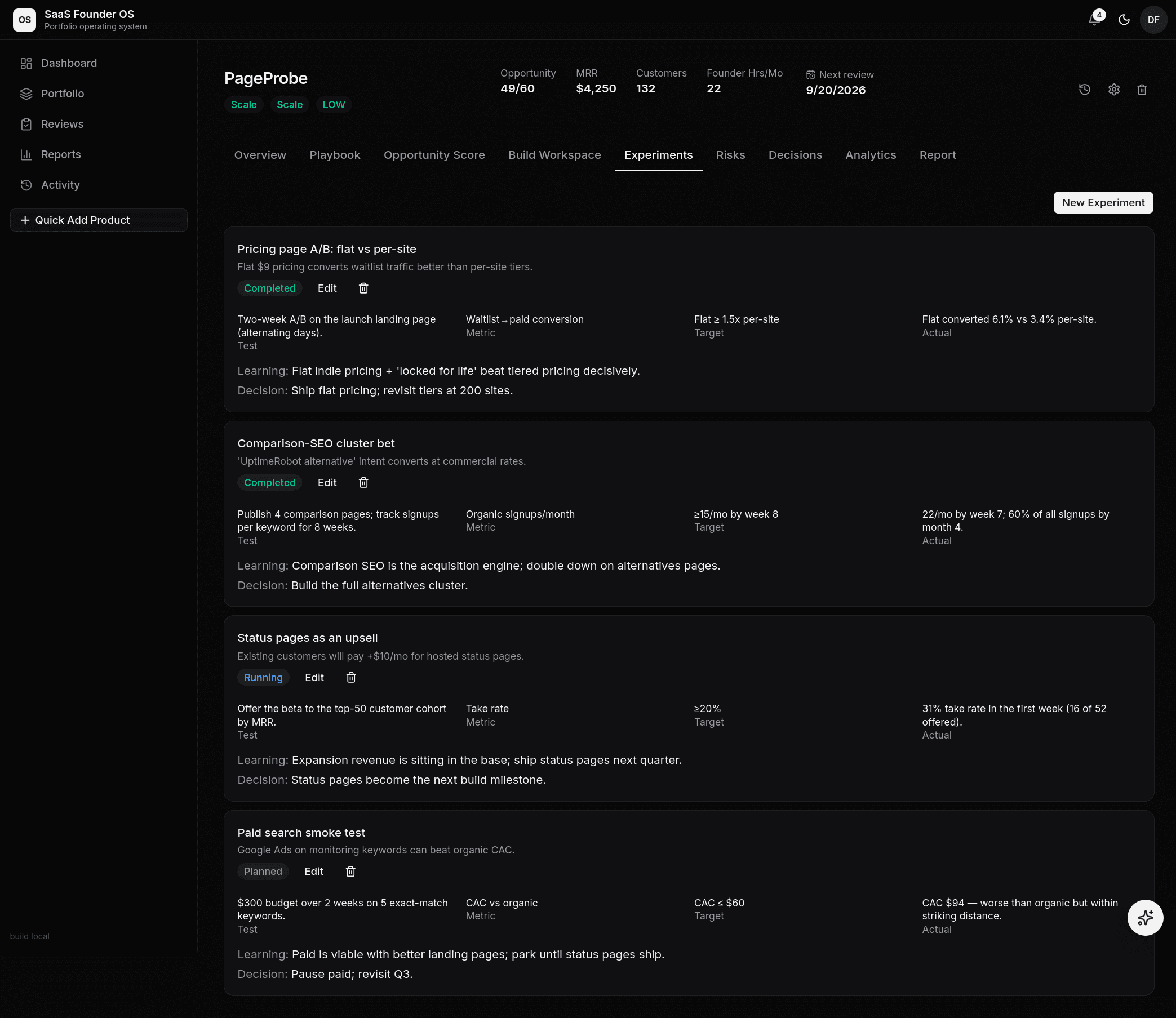 The experiments list — hypothesis, test, metric and target, actual result,
and the learning and decision recorded when the experiment closes.
The experiments list — hypothesis, test, metric and target, actual result,
and the learning and decision recorded when the experiment closes.
Why the structure matters
An experiment with no target can't fail, and an experiment that can't fail teaches nothing. The stage gates consume completed experiments as evidence: VALIDATE → BUILD, for example, requires at least one completed experiment. The engine reads them too — a stalled RUNNING experiment shows up as a next action ("decide this experiment") until you close it.
The habit
Design small. A landing page with a pricing column beats a six-week build "test". When an experiment completes, write the learning in one sentence a tired founder could act on — that sentence is what future-you reads during portfolio reviews when deciding what to kill.