

The only metrics that matter at $0
Founder Playbook · MRR stage. Signups, activation, first payment — and why most dashboards are lying to you.
The MRR stage answers one question: can it make money? Not "did people star it" or "did the launch get upvotes." The jump from LAUNCH to MRR is the first time your product faces commercial reality — and the metrics that matter are fewer than you think.
Signups, activation, first payment
Everything reduces to a three-step funnel:
- Signups — people arrived. (Distribution works. Barely interesting.)
- Activation — they did the thing the product is for. (This is where most products quietly die.)
- First payment — someone exchanged money for value. (The only unfakeable signal in software.)
Watch the conversion between the steps, not the totals. 500 signups and zero activations is a product problem dressed as a marketing problem. Fix the leak with the fewest people through it before pouring more in.
Your dashboard is lying to you (vanity vs signal)
Totals always go up; rates tell the truth. Cumulative signups, downloads, pageviews, followers — every one of them can rise while the product dies. The honest metrics are rates and cohorts: activation rate this week, week-2 retention of last month's signup cohort, revenue per new user. If a metric can't go down when things get worse, it's decoration.
Churn math for people who hate math
Monthly churn of 10% means the average customer stays ten months — fine. It also means you must replace a tenth of your base every month just to stand still. At 20%, you're on a treadmill that speeds up. You don't need a finance degree: divide cancellations by the base, look at it monthly, and treat a bad trend like a stage-gate blockage — named, investigated, fixed.
Where the OS enforces this
- Live Data Feeds pull MRR, customers, and churn in from Stripe-shaped webhooks — the numbers you argue with are the real ones, delivered on their own.
- Reports turn the numbers into per-product economics: MRR, ARPU, costs, and a founder-adjusted net.
- The MRR gate requires actual, feed-verified revenue — hand-entered optimism doesn't advance stages.
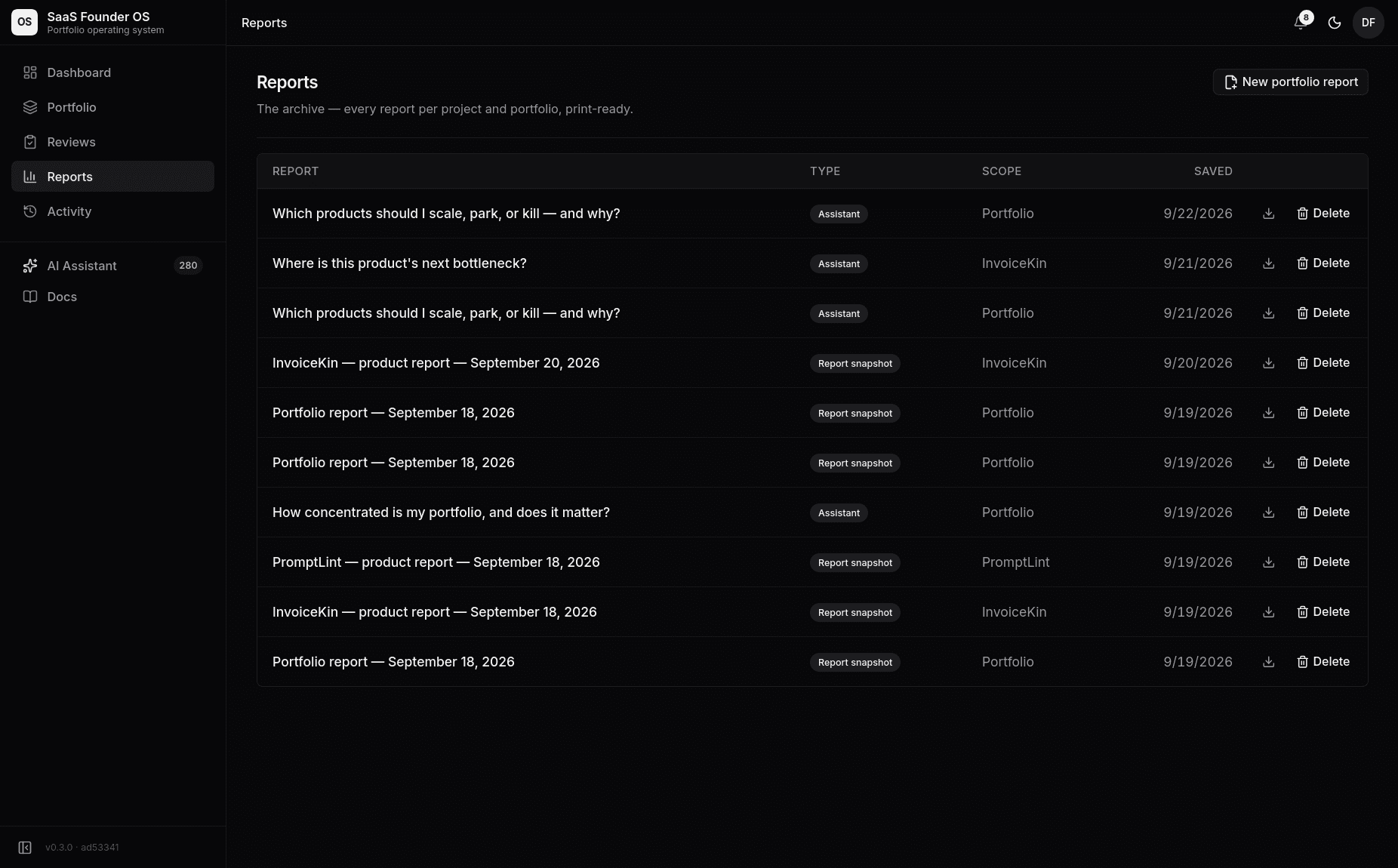 Reports — the portfolio's numbers, including the founder-adjusted net that
subtracts your own hours.
Reports — the portfolio's numbers, including the founder-adjusted net that
subtracts your own hours.
Next: Scale is allocation.
Launch is a checklist, not a mood
Founder Playbook · LAUNCH stage. Launch day is the easy part — the first ten users and the measurement plan are the actual work.
Scale is allocation
Founder Playbook · SCALE stage. Doubling down on the winner, automating the runner-up — and why one product earns the right to become the company.