

Score it before you build it
Founder Playbook · The Opportunity Score. Twelve weighted criteria that turn "I have a feeling" into a number you can argue with.
Gut feel is a real signal — it's just a biased one. It overweights novelty and underweights distribution, every time. The Opportunity Score exists to put arithmetic between you and your enthusiasm, across the whole portfolio, on the same rubric.
The 12-criterion scorecard
Every candidate is scored on twelve weighted signals covering the dimensions that actually decide outcomes: the problem's pain and frequency, the market's size and reachability, competition, distribution path, pricing headroom, and the honest effort estimate. Score each 0–5; the weights do the arguing.
Two rules make it work:
- Score honestly, not strategically. The scorecard only helps if you let your favorite idea lose. That's the entire point.
- Score all the candidates. A score without comparisons is trivia. The portfolio view — best score, worst score, and the gap — is the decision.
Why your favorite idea scored last
It happens to everyone, and it's the best outcome the scorecard can produce. The idea you love most is the one you've thought about longest, which means your estimate of it is the most contaminated by sunk-cost and novelty bias. When the score disagrees with your gut, don't throw the score away — write down why the gut disagrees. If the gut has a reason the rubric missed, that's a real signal. If it's just excitement, you just dodged six months.
A worked example, end to end
The demo product that ships with every account (ChurnPilot) carries a complete scorecard — criteria, weights, and the recommendation the numbers produced. Read it before scoring your first idea; it's the fastest way to see what "scored honestly" looks like.
Where the OS enforces this
- The scorecard computes the weighted score and shows the recommendation — with your overrides and their reasons on the record.
- Scores feed portfolio reviews — when two products compete for the same hours, the numbers are already on the table.
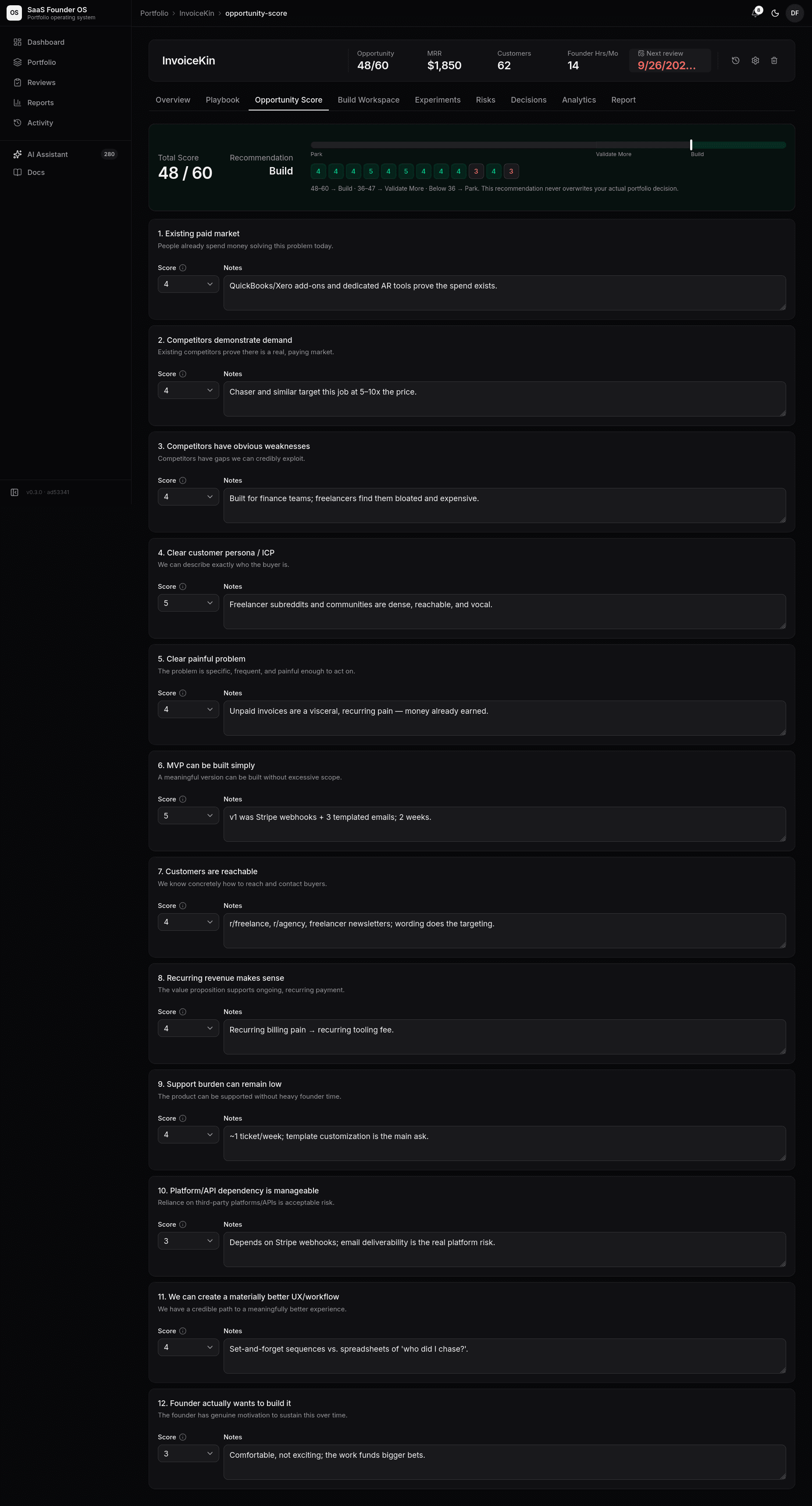 Twelve criteria, one number, no vibes. The recommendation banner is the
system's argument — you're free to overrule it, in writing.
Twelve criteria, one number, no vibes. The recommendation banner is the
system's argument — you're free to overrule it, in writing.
Next: Vibe-code less, scope more.
Evidence before code
Founder Playbook · VALIDATE stage. The 2-week test, why landing-page validation is fake, and the only proof that counts.
Vibe-code less, scope more
Founder Playbook · BUILD stage. AI made shipping easy and scoping hard — gates, next actions, and cutting the feature list on purpose.