

Vibe-code less, scope more
Founder Playbook · BUILD stage. AI made shipping easy and scoping hard — gates, next actions, and cutting the feature list on purpose.
AI changed the bottleneck. Building stopped being hard; deciding what not to build became the whole game. The BUILD stage is where founders with fast hands lose their way — and where the smallest scoped thing wins.
The MVP is the feature list you cut
An MVP is not "version 1 with everything." It's the smallest thing that tests the thesis you wrote in the IDEA stage — nothing more. The practical test for every feature: if I cut this, does the experiment still produce its signal? If yes, it's version 2. Or 5. Write it down and move on.
The feature list you cut is also a promise to your future self: when the "just one more thing" urge hits at 11 PM, the list is the pre-made decision you already made with a clear head.
Gates hold the line
Moving from BUILD to LAUNCH isn't a vibe — the gate names what must be true: working software in front of real users, core flows stable, the experiments that justify the build recorded. The gate can be overridden — but the override and the missing evidence are logged, and you'll see them again at the review.
Next actions, not whims
Every build session starts the same way: open the workspace, do the thing the system already ranked. Not the fun task — the next action. Momentum isn't built by coding fast; it's built by never re-deciding what to work on.
Where the OS enforces this
- The Build Workspace holds tasks and the playbook work in one place, so 11 PM sessions start with a decision that's already made.
- Stage gates name the launch requirements — and log overrides.
- The risk register catches the known-unknowns while they're still cheap.
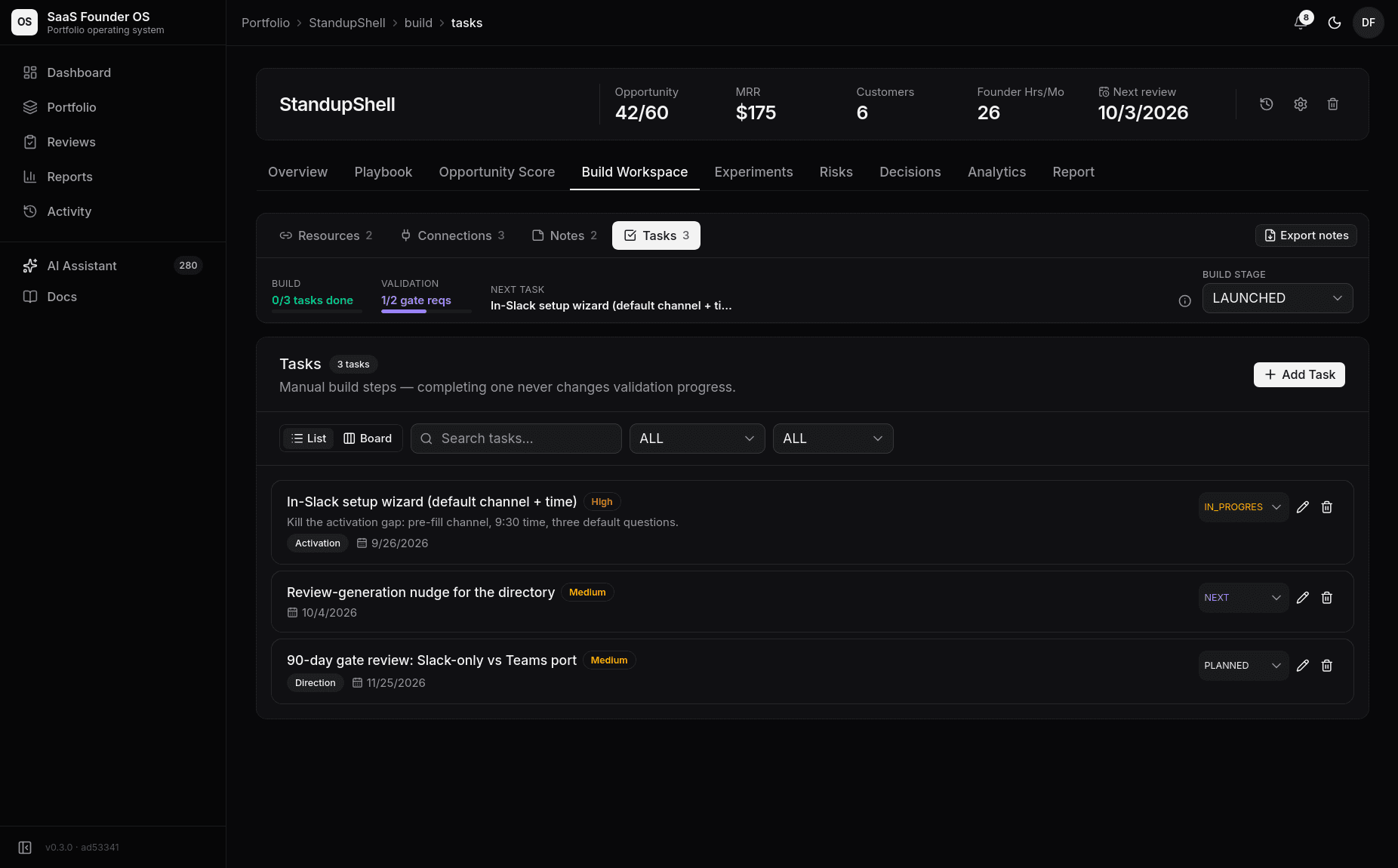 The Build Workspace — the task list you're allowed to trust, because it
was ranked when you were thinking clearly.
The Build Workspace — the task list you're allowed to trust, because it
was ranked when you were thinking clearly.
Score it before you build it
Founder Playbook · The Opportunity Score. Twelve weighted criteria that turn "I have a feeling" into a number you can argue with.
Launch is a checklist, not a mood
Founder Playbook · LAUNCH stage. Launch day is the easy part — the first ten users and the measurement plan are the actual work.