

Scale is allocation
Founder Playbook · SCALE stage. Doubling down on the winner, automating the runner-up — and why one product earns the right to become the company.
Scale isn't "grow faster." It's an allocation decision: of your hours, your attention, and your next six months — which product earns them? The SCALE stage is where the portfolio stops being a collection and starts being a strategy.
When to scale — and when you're just decorating
The honest trigger is economic, not emotional: MRR that's real and trending up, churn that's survivable, and activation that holds as volume grows. If you "scale" a product that hasn't proven retention, you're paying to fill a leaky bucket — that's decorating, not scaling. The gate asks for sustained, feed-verified numbers precisely so this decision can't be made on a good launch week.
One product earns the right to become the company
Look at the one-product companies you admire: they look invincible until you remember they got there by sequencing. The portfolio pattern most multi-product founders converge on:
- SCALE the winner — the highest-scoring, best-economics product gets company-level focus. One product eventually is the company; the portfolio decides which.
- MAINTAIN the runner-up — cash-flow at a few hours a week, funding the main bet.
- SELL the third — a product with a documented scorecard, gate evidence, and an MRR trend is a due-diligence packet. Documented, boring, and cash-flowing is exactly what micro-acquisition buyers pay for.
Spin out a legal entity only when a product earns it — a SCALE decision with sustained economics or a sale. Branding per winner before the math says so is decision debt of the legal kind.
The review is where allocation happens
Scale decisions are portfolio decisions — they need the comparison in front of you: scores, trends, concentration, and the decision history of every product. Make them in the review, with a rationale, on the record.
Where the OS enforces this
- Portfolio reviews force the explicit decision — Scale, Maintain, Sell, Park, or Kill — with a written rationale. "Everything stays as it is" is the one answer the review doesn't accept.
- Reports show concentration and sellability — how much of your MRR rides on your biggest product, and whether the portfolio reads as one asset.
- Decision timelines keep the history: why you scaled, what you expected, what actually happened.
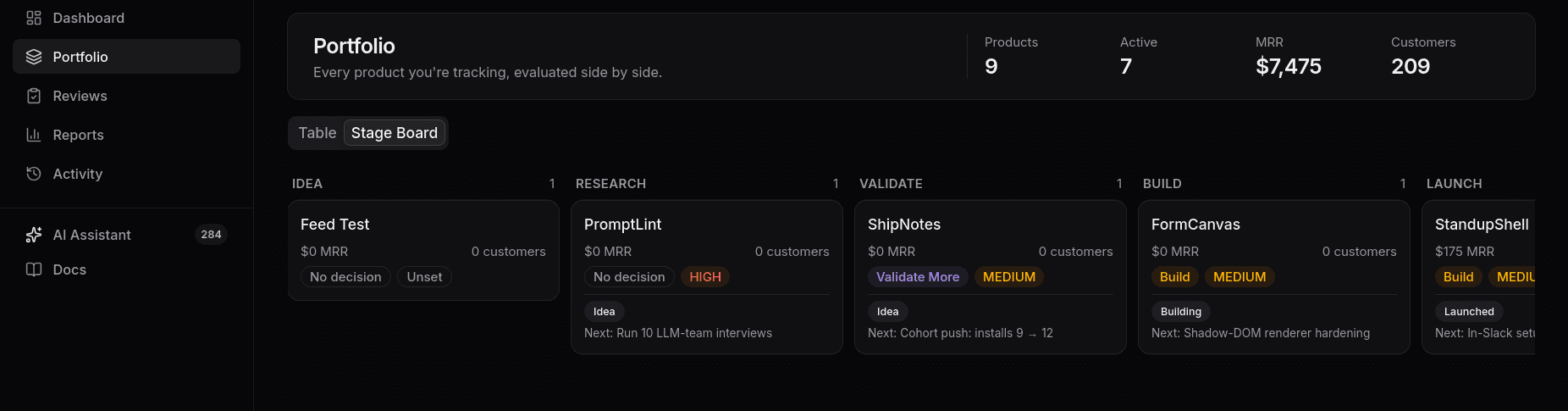 The stage board — allocation starts with seeing every bet in one place.
Next: Boring is profitable.